Australia's Failing Nicotine Policies

Written by Greg Chipp
April 17, 2026

Australia was once a world leader in the field of tobacco control. Plain packaging and high taxes were considered a public health success, but the current approach is becoming increasingly counterproductive.
As the international community shifts toward more practical, health-led policies, Australia is doubling down on its restrictive approach to nicotine.
Whether it’s cigarettes, vapes, or oral nicotine pouches, these products are all just different ways of delivering nicotine. Treating nicotine as a prohibited drug with criminal sanctions for supply rather than a matter of public health is driving a large and growing black market. Which ultimately leaves consumers with fewer safe and regulated options.
The evidence suggests it is time for a new approach, one that prioritises regulation over prohibition.
The Tobacco Pricing Model
For years, Australia’s main tobacco control strategy has been straightforward: make cigarettes more expensive, and in turn less accessible. Tobacco excise is indexed twice a year, with an extra 5% increase annually. Since 2020, tobacco taxes have risen by almost 60%, pushing the price of a pack of cigarettes upwards of $50.
If smoking becomes too expensive, the assumption is that fewer people will smoke. But recent data suggests this model is doing more harm than good.
Federal tobacco excise revenue has fallen rapidly from its peak of $16.3 billion in 2020-21 to just $7.4 billion in 2024-25. However, this decrease in legal cigarette purchases is not due to a decrease in consumption. In 2024, the government appointed an Illicit Tobacco and E-cigarette Commissioner to investigate the illegal nicotine market. They are now warning that the black market may account for as much as 55% of all nicotine products consumed.
Even politicians are starting to acknowledge the problem. NSW Premier Chris Minns said that “ultimately this is all being driven by federal government tax that is not working.”
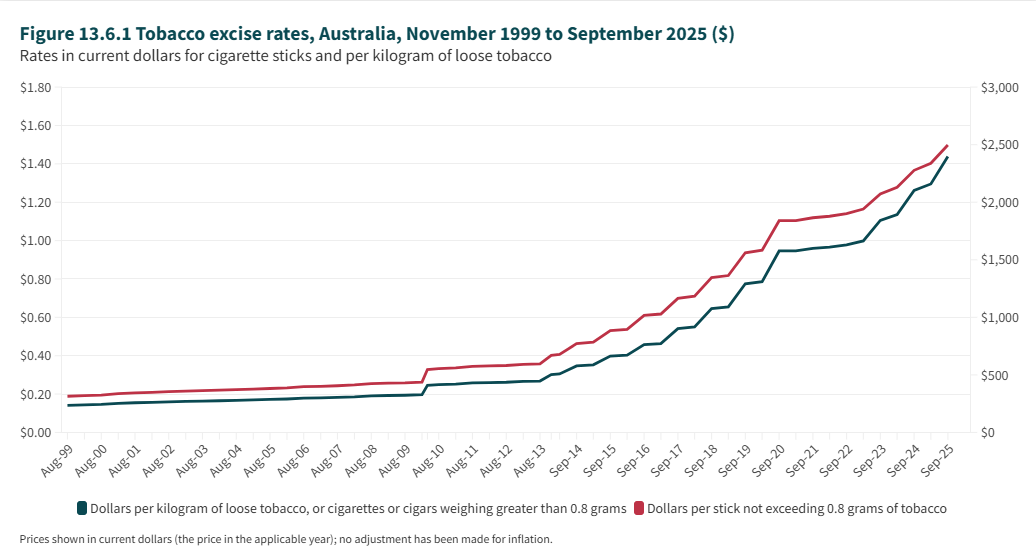 Source: Australian Taxation Office via Tobacco in Australia
The Unintended Consequences of Prohibitive Taxation
Excessively high taxes and restrictive regulation have placed a lucrative market into the hands of organised crime, with the illicit nicotine trade now worth an estimated $5.6 billion.
That black market has expanded access to unregulated nicotine products and has also fuelled extreme violence. In Victoria alone, there have been over 100 firebombings of storefronts linked to the illicit tobacco trade, as criminal groups fight for market control.
The government response to these attacks has been to escalate enforcement. Tobacco Licensing Victoria now has the power to close retail stores that are found selling illicit products, instead of just seizing supply. But shutting down shops does not reduce demand for nicotine. It simply pushes the market further underground.
As storefronts disappear, supply will move into harder-to-monitor networks like private homes and informal sellers. We have seen this before in other illicit markets. By targeting the visible retail layer without addressing demand, the government risks creating a market that is even more hidden, fragmented, and challenging to regulate.
The Vape Medical Model
In October 2024, Australia introduced a world-first “pharmacy-only” model for vaping products. The goal was to reduce youth access while positioning vaping as a therapeutic avenue for adults trying to quit smoking.
While the new model appears more sensible, it has created major barriers to access.
For many nicotine users, the pharmacy model is not accessible and is disconnected from how people actually use these products. Rather than encouraging people into formal cessation pathways, it often pushes them toward the black market instead.
 Image of someone choosing a vape in a store
What Are Other Countries Doing?
While Australia has tightened restrictions on nicotine through higher taxes and tougher access rules, other countries have taken a different path. They have embraced harm reduction, treating lower-risk nicotine products as practical alternatives to smoking.
The United Kingdom is often cited as a leading example. Its “Swap to Stop” program provides free vaping kits to smokers and openly promotes vaping as far less harmful than combustible tobacco. Their approach is simple; cigarettes are the greatest health risk, and safer nicotine alternatives can help reduce that harm.
New Zealand offers another useful comparison. Like Australia, it taxes tobacco heavily, but it has also maintained a regulated consumer market for vaping products. That combination has helped reduce smoking rates at roughly twice the pace seen in Australia. By making alternatives both legal and accessible, New Zealand has enabled many smokers to stop using combustible tobacco.
Sweden may provide the strongest case of all. Rather than relying on vaping as the main smoking alternative, the country has long embraced smokeless nicotine products like snus. By keeping these alternatives available, Sweden has achieved a daily smoking rate of about 5.6%, the lowest in Europe, and is on its way to becoming the first European nation to achieve a “smoke free” status (daily smoking rate under 5%).
The lesson from all three countries is the same: when safer nicotine alternatives are accessible, smoking rates decline.
It’s Time for a Different Approach
Critics often treat continued nicotine use as a policy failure, but that “quit or die” mindset is entwined in prohibitionist thinking. It assumes the only acceptable outcome is total abstinence, even when safer alternatives are available.
Australia’s current approach punishes nicotine users rather than protecting them. By restricting vapes to pharmacies and driving up prices, millions of people are being pushed away from safer, regulated products and into an unregulated black market.
At Drug Policy Australia, we believe policy should reflect reality. Nicotine use is a public health issue, and it should be treated as such. That means laws that are person-centred and focused on reducing harm.
As former Border Force officer Rohan Pike put it, “we need harm minimisation in concert with enforcement measures,” and to “rebalance the market and give the legal price a chance to compete with the illegal price”.
If Australia is serious about improving public health, it must move toward a regulated, consumer-led nicotine model. The experiences of the UK, New Zealand, and Sweden show that when people are given safer, affordable options, they take them. It is time to stop fighting a war on nicotine and start supporting the health, safety, and agency of the public.
Sign in to comment
Get Involved and Join the Movement