Newsletter April 2026

Written by Greg Chipp
April 23, 2026

2026 is already proving to be a crucial year for drug policy reform.
At the 69th Commission on Narcotic Drugs in March, the long-promised review panel for the UN drug treaties was finally locked in. Better still, the United States’ prohibitionist rhetoric was overwhelmingly rejected by the majority of member states.
In Australia, state governments are finally beginning to confront the absurdity of cannabis driving laws that punish people who are not impaired.
But while there are signs of progress, prohibitionist thinking is alive and well. Governments across Australia are intensifying their crackdown on illicit tobacco sales, while fanning the flames with exponential taxation increases. Won't they ever learn that prohibition does not work and creates more problems than it solves.
Read on for the details but first, the good news.

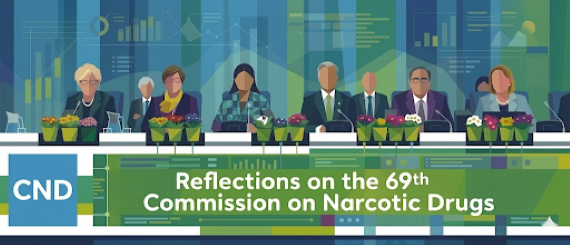
United Nations 69th CND
The 69th Session of the United Nations Commission on Narcotic Drugs (CND) was held in March and built on the reform momentum of previous years
Following progress at the 67th and 68th CND, the 69th reaffirmed the international commitment to including harm reduction, human rights and environmental sustainability in its deliberations.
The biggest development was the finalisation of the independent expert panel, created at last year’s CND, to review the UN drug treaties. In welcome news, Australia’s Michael Farrell, a respected harm reduction advocate, has been appointed to the panel as the World Health Organisation representative.
Additionally, the US’s call to remove references to the Sustainable Development Goals was rejected by the overwhelming majority, supported only by 3 countries.
Read more about the deliberations at the 69th CND here.
Medicinal Cannabis Driving Laws Under Scrutiny
Cannabis driving laws vary from state to state. Tasmania is the only state that allows unimpaired drivers with medicinal cannabis prescriptions to legally drive.
In Victoria, recent reforms allow those with a prescription to avoid a mandatory loss of license by appealing to a magistrate. Although this is a welcome development it is also problematic as drivers are still charged and must appeal their suspension in court.
All other states have a zero tolerance approach for driving with any detectable cannabis in your system regardless of having a prescription.
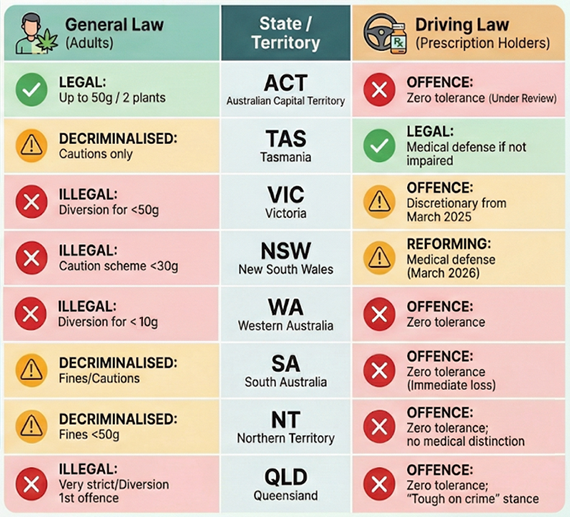
The good news is that NSW Premier Chris Minns has committed to reforming the state's cannabis driving laws, saying recently, “we’re actively considering a change in the policy” when talking about roadside cannabis testing laws.
It's time to start treating medicinal cannabis like any other prescription.

Australia Ratchets up Nicotine Prohibition
Australia’s illicit tobacco market, estimated to be worth over 5 billion dollars is continuing to boom at the expense of the legal market. For the first time the black market now accounts for the majority of nicotine products consumed in Australia.

Rather than admit that excessive taxation drives the black market, Australia’s nicotine prohibition regime is tightening across both vaping and tobacco. All states are expanding powers to crack down on shops selling illicit nicotine products. Changes across NSW, Queensland and Victoria, include stronger closure powers, tougher penalties, wider seizure powers, and stricter licensing rules for retailers.
Taken together, these changes show nicotine policy drifting towards prohibition and further away from health focused harm reduction.
Read more about Australia’s failing nicotine policies here.
NSW Calls for Tobacco Excise Review
In a positive development, NSW Premier Chris Minns has called on the Federal government to acknowledge that the exorbitant excise tax is feeding the growth of the illicit tobacco market.
He said that "we need to have a look at how big this excise is, and how it's driving illegal tobacco sales in our community."
New Victorian Tobacco Laws
In a futile effort to eradicate the illicit tobacco market, Victoria has introduced a stringent tobacco licensing scheme.
Under the new laws, retailers and wholesalers must obtain a licence to sell tobacco, while inspectors will have the power to seize products and shut down shops. Businesses caught selling illicit tobacco will face fines of up to $1.8 million which is still a drop in the ocean when compared to the billion dollar illicit market.
Surely it’s time to reduce the tobacco excise to have a fighting chance against the black market.
Failure of the NSW Early Drug Diversion Initiative
Since its inception, NSW's EDDI program has been criticised for its discriminatory and arbitrary application by police. The program was intended to divert low-level drug offenders from the criminal justice system.
Due to its strict eligibility requirements, 72% of people found in possession cannot be considered for diversion, and police discretion further reduces its impact. Among those found eligible, only one in five is actually diverted. Overall less than 10% of individuals actually avoided court.
The eligibility requirements of this program favour those with privilege. The most commonly diverted individuals are cocaine and MDMA users, and non-Indigenous Australians.
Queensland is experiencing similar bias with their drug diversion program. The new conservative government has scrapped the previous three-strike model in favour of a more restrictive one strike.
For more information about EDDI diversions, read the BOCSAR report here.
AFL Introduces Hair Testing for Illicit Drugs
The AFL’s revamped illicit drug policy has been described as the “most stringent in Australian sport”.
Under the new regime, players will be subjected to hair testing in the name of keeping role models squeaky clean. The logic is familiar and tired: if an athlete uses illicit drugs in their private life, it must be treated as a moral failure rather than a health issue, or better yet, nobody else’s business.
This is not about performance enhancement. Drugs like cannabis and LSD are hardly helping anyone dominate on the field. It is moral policing dressed up as player welfare.
If the AFL is serious about leadership, it might start by updating its attitudes, rather than obsessing over what players may have done on a night off.

Militarisation of the War on Drugs
In December, we reported the US attacks on suspected drug boats and the widely condemned, double-tap strike on survivors clinging to the wreckage. The Trump administration has since used the fentanyl crisis to justify attacking a sovereign country, namely Venezuela.
The operation in Venezuela marks a dangerous moment in the militarisation of the drug war, where human rights and international norms are being ignored. In the attack on Venezuela, missile strikes killed at least 180 people and injured more than 100.
In the name of the war on drugs, President Nicolas Maduro and his wife were kidnapped to the US to face trial on drug dealing charges.
Although Maduro may object to being kidnapped in an illegal operation, it’s still preferable to being blown up in a small boat.
Trump’s Psychedelic Plot Twist
On April 18th, Donald Trump signed a surprising Executive Order to fast track research and funding into psychedelic drugs.
The order directs the U.S. Food and Drug Administration to speed up the approval of psychedelic medicines and commits $50 million in federal funding for research. A primary focus of the directive is the study of ibogaine, for its potential in treating severe PTSD and depression.
The order also directs federal agencies including the Drug Enforcement Administration (DEA) to cut the red tape that has kept psychedelics in the dark too long.
I worry Trump’s support could give psychedelics a bad name, but good onya Donald. Perhaps you should start with taking some of your own medicine.
Thailand’s New Medical Cannabis Laws
Since our last newsletter, Thailand’s indecisive stance on cannabis has remained an ongoing debate especially with the new government.
Since last year’s rule change requiring a prescription for cannabis flower, many of Thailand’s 18,000 dispensaries have shut their doors. But thousands are still open especially in the main tourist beats.
Ironically, edibles remain available without a prescription, and tourists can still access top-shelf cannabis buds at many shops with an on-site “medical practitioner" ready to write a script.
But the good news is that there are seven types of medical practitioners including, Traditional Thai Medicine Practitioners, Licensed Folk Healers, Chinese Traditional Medicine Practitioners, Licensed Pharmacists and Dentists.
So if you’re planning to smoke cannabis in Thailand, make sure you get a prescription from a licensed dispensary with an in house tourist friendly doctor.
DRUG ALERT: Protonitazene Detected
On the 3rd of April CanTEST issued an alert for protonitazene, a synthetic opioid, that was found in a sample reported as heroin. Protonitazene is approximately 200 times stronger than morphine,severely increasing the risk of overdose.
The growing number of similar reports reveals that dangerous synthetic opioids are appearing more frequently in Australia’s drug supply.
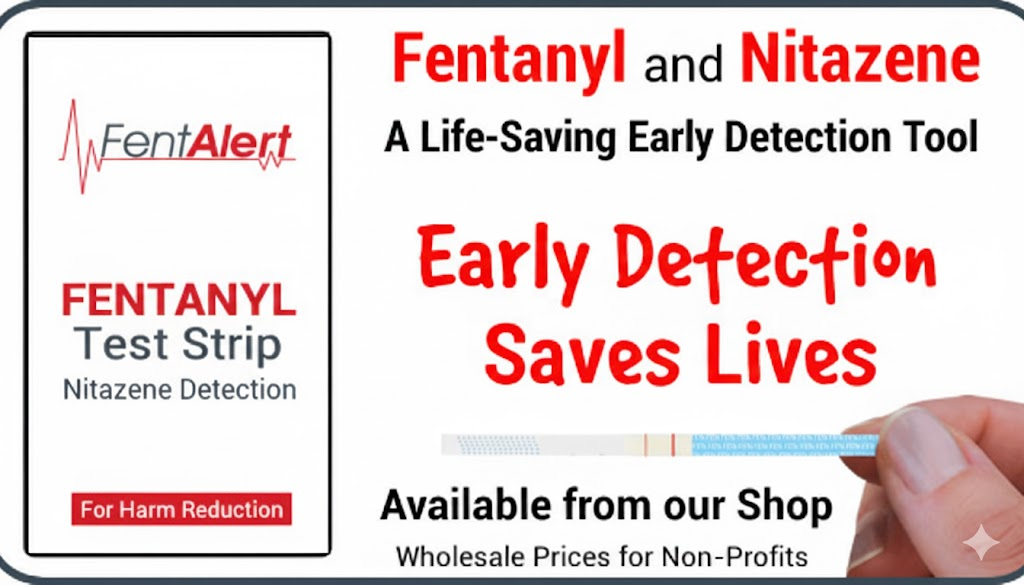
Nitazenes can be easily detected through the use of drug testing strips. If you or someone you care about is using drugs, please consider purchasing some test strips.
If you or someone you care about is using drugs, please consider purchasing some test strips.
You can purchase fentanyl and nitazene test strips directly through our website here.
To stay up to date on drug alerts in Australia follow The Know.
Help Prevent Further Overdose Deaths
Your donation helps us advocate for evidence-based reform and support those most at risk.
As a small, self-funded charity, we do not accept government funding, which would compromise our ability to advocate for reform. We rely on your generosity to continue our work for sensible drug policies that reduce harm and promote human rights.
All donations are fully tax-deductible.
Free E-book: The Case for Reform
Want to talk with your loved ones about drug policy reform but don't have all the answers?
Download our FREE Case for Reform eBook here. Equip yourself with the tools to educate your friends and family on the ins and outs of drug reform.
Final Thoughts - Please Support Drug Policy Australia
One Australian dies every four hours from an accidental overdose. These deaths are often preventable. Yet ignorance, stigma, and punitive legislation continue to push vulnerable people over the edge.
Having recovered from my own heroin addiction, I have an intimate understanding that these laws are fundamentally ineffective. They did not help me then, and they are failing the thousands of Australian families who need help today.
When 64% of Australia’s drug policy budget is spent on law enforcement at the expense of treatment, and when police are still targeting vulnerable members of our community - including children - with invasive and unlawful searches, we know that justice is being compromised.
If you share our vision of a compassionate and effective approach to drug policy, please consider making a tax-deductible donation today. Your support helps us in our fight to save lives, challenge stigma, and demand real change.
Finally, to our growing community of supporters: thank you. Together, we’re building a future where evidence, not fear, guides drug policy.
Please phone me anytime on 0417 773 372.
Greg Chipp
Managing Director
Dr John Sherman, Lisa van Rooyen
Directors
Sign in to comment
Get Involved and Join the Movement