United Nations Supports Harm Reduction and Drug Treaty Review

Written by Greg Chipp
March 20, 2026
As the 69th annual Commission on Narcotic Drugs (CND) wrapped up in Vienna on the 13th of March, you can feel change is in the air. From the first breakthrough on harm reduction at the 67th CND, to the creation of an independent expert panel at the 68th, and its full establishment at the 69th, harm reduction has arrived at the United Nations.
For decades, the CND operated under the "Vienna consensus", a tradition of unanimity that allowed individual states to veto progressive reforms. After the 67th CND, the unanimous voting method was overturned, ushering in a new era of growth, moving the policy debate away from prohibition.
A slow but real shift in Vienna
For decades, the CND was one of the key actors perpetuating the global war on drugs. It helped preserve a system that favoured harsher enforcement. However instead, it produced mass stigma, incarceration, and preventable deaths while doing little to reduce the harms associated with drug use. The 69th CND showed that the old prohibitionist consensus on drug policy is weakening.
That change has been building across the last three sessions of the Commission. The 67th CND formally introduced harm reduction. The 68th moved to review the system more seriously by creating an independent expert panel.
The 67th CND broke a taboo
The 67th CND formally adopted the term “harm reduction” in a resolution. While it might appear to be a minor adjustment, in Vienna this was a breakthrough in moving towards human rights based policy. Prohibitionist states had long treated even basic public health language as politically dangerous. But, once that barrier fell, it became much harder to pretend that the Commission could keep ignoring the evidence for practical interventions that save lives.
The 68th CND went further
At the 68th CND, the progress became more structural. The Commission voted to establish a multidisciplinary panel of 19 independent experts, serving in a personal capacity, to prepare recommendations ahead of the 2029 global drug policy review. According to the International Drug Policy Consortium (IDPC), the panel’s mandate covers not just the three drug treaties, but also other relevant international drug policy commitments. This creates an opportunity for the development of a broader framework, rather than treating the old conventions as the only perspective that matters.
CND affirms Sustainable Development Goals
At the plenary session of the 69th CND, the US introduced a motion to remove the Sustainable Development Goals (SDGs) from the CND’s standing agenda. This motion was an attempt to decouple drug policy from the broader UN commitments to sustainable development and human rights.
Fortunately, this hardline approach found few supporters. The motion was defeated, 45 to 3, leaving the US isolated alongside a shrinking group of hardline allies. The international community can no longer disregard fundamental human rights in pursuit of a drug-free world.
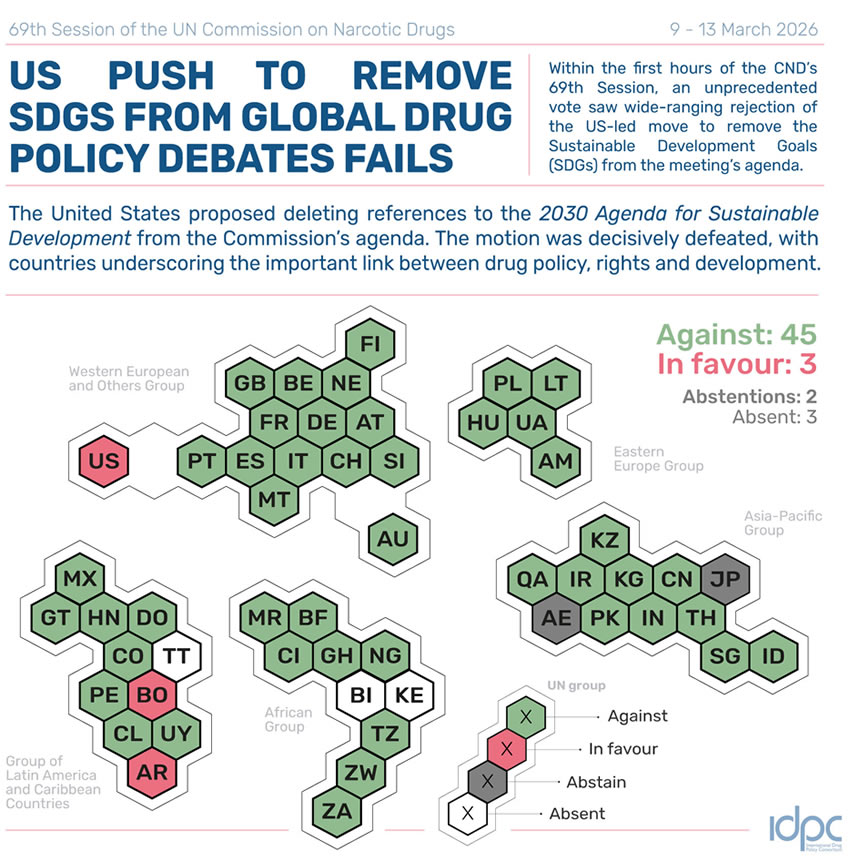
IDPC graphic showing the vote to delete references to the 2030 Agenda for Sustainable Development from the Commission's agenda.
The expert panel
The 69th CND was the session where the panel was finally appointed. The United Nations Office of Drugs and Crime (UNODC) also confirmed the panel’s role: to strengthen implementation of the international drug control treaties ahead of the 2029 review.
The same session also adopted five resolutions, including one promoting evidence-based responses grounded in human rights. This does not mean Vienna has fully eliminated prohibitionist thinking, but it does show a shift towards a rights-based approach embedded in the Commission’s work.
The panel matters, but so do its limits
The expert panel could be one of the most important developments in international drug policy in years. If it does its job properly, it could help expose the failures of the existing regime and point towards more humane and effective frameworks.
The panel includes members selected by the Commission, the UN Secretary-General, the International Narcotics Control Board and the World Health Organization. One to note is Australia’s Michael Farrell as the WHO representative. As the Director of the National Drug and Alcohol Research Centre, Farrell is a world-leading expert in addiction psychiatry. His presence is a crucial safeguard, providing an evidence-based link to public health.
But there are still reasons to be cautious. Even where members serve in a personal capacity, they are still often elected from official, diplomatic, and institutional circles, leaving the people most harmed by prohibition often underrepresented. The IDPC also warned when the panel was created that the process could be shaped too heavily by UNODC, raising legitimate concerns about independence and bias.
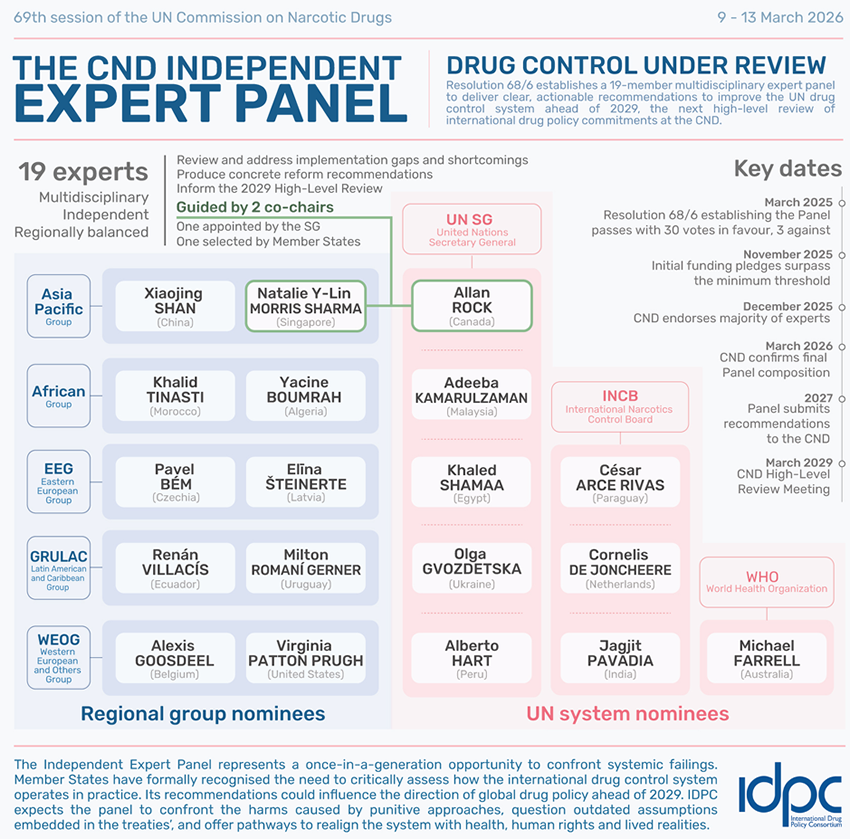
Graphic showing the 19 members of the CND expert panel.
The way forward
The 69th CND did not end the drug war. But it did confirm that old attitudes are fading. Across three consecutive sessions, the Commission has moved from cautiously recognising harm reduction, to authorising a serious review mechanism, to formally establishing the panel that could shape the ongoing drug policy debate. That is not enough, but it is progress.
It’s now clear that the prohibitionist model is no longer unchallenged, and that the US is no longer able to dictate the terms of the discussion as it once did. If drug policy is to be genuinely evidence-based, then it must keep moving away from punishment and towards a rights-based approach.
Sign in to comment
Get Involved and Join the Movement