
Why the UN’s 68th Session of the Commission on Narcotic Drugs Matters
Written by Caitlin Hull
September 12, 2025

Who really calls the shots on global drug policy? Beyond headlines of military-style drug busts lies a sprawling international framework administered through three United Nations drug treaties. These conventions, enforced by an intricate web of committees and boards, shape how governments police, punish, and treat drug use.
At the centre of this system is the UN Commission on Narcotic Drugs (CND), a rotating body of 53 member states that meets annually in Vienna. Its decisions ripple far beyond its chamber: into national laws, health systems, human rights protections, and security strategies. For decades, the CND operated under consensus, effectively giving prohibitionist states such as the United States a veto. Harm reduction and human rights language rarely made it into resolutions.
That changed in 2024. At the 67th CND, after years of deadlock, member states broke with tradition and voted. For the first time, harm reduction was explicitly endorsed. The 68th session, held in March 2025, went even further: it launched the first-ever independent review of the foundations of international drug control.
This isn’t only about illicit substances. It’s about public health, organized crime, Indigenous rights, environmental damage, and ultimately, international stability itself.
A Short History of Global Drug Control
The current system rests on three treaties:
1961 Single Convention on Narcotic Drugs: Established the CND and the International Narcotics Control Board (INCB), defining substances like opiates, cannabis, and coca as “narcotics.” It limited their use to medical and scientific purposes. The World Health Organisation (WHO) was additionally tasked with providing expert scientific input.
1971 Convention on Psychotropic Substances: Expanded control to synthetic drugs like LSD, reflecting anxieties about new psychoactive substances.
1988 Convention Against Illicit Traffic: The punitive turn, criminalising trafficking and even possession, embedding the “war on drugs” globally.
For six decades, this regime supported a punitive status quo. Critics now argue it is outdated, ineffective, and harmful.
Vienna 2025: What Went Down at the 68th CND
The latest session drew over 2,000 participants from a veritable melting pot of over 100 Member states, UN agencies, NGOs, and experts. Four issues dominated:
1. Synthetic drugs: Fentanyl and other new opioids driving overdose crises.
2. Cannabis: Following the WHO’s 2020 recognition of medical value and global legalisation trends.
3. Crime and technology: Links between trafficking, dark web trade, AI, and financial evasion.
4. Environment: Deforestation and chemical pollution from illicit cultivation.
The session passed the usual unremarkable resolutions, including placing six new opioids under control, adopting six further measures on youth prevention, law enforcement safety, and international cooperation. But the historic outcome was the vote to establish an independent review of the conventions.
Power Struggles and Policy Shifts
The CND remains divided. Reformist countries and NGOs argue the treaties block modern solutions such as decriminalisation and cannabis regulation, and that criminalisation undermines human rights and public health.
Civil society also pushed for recognition of Indigenous practices, such as traditional coca use. Harm reduction advocates challenged the INCB’s conservative interpretations, accusing the Board of stifling innovation.
At the 68th session, these tensions were unmistakable.
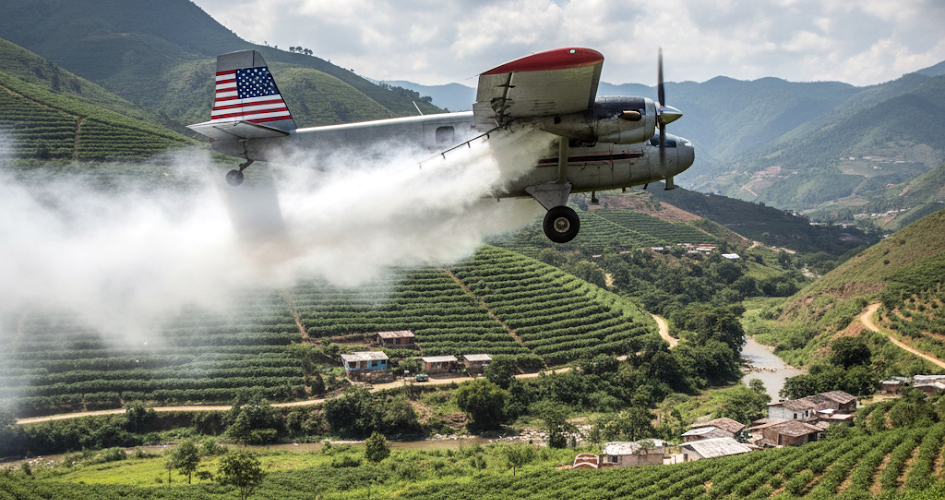
AI-generated image of coca crop arial fumigation in Colombia
A Historic Vote: The Independent Review Panel
Led by Colombia, a coalition of 60 states secured a vote to establish a 19-member expert panel to review the treaties. The resolution passed with 30 votes in favour, 18 abstentions, and Argentina, Russia, and the United States voting against.
The panel must deliver recommendations by March 2027, potentially paving the way for countries to regulate cannabis, decriminalise use, and integrate health and human rights more fully into drug control.
But concerns remain. Of the 19 members:
- 10 will be chosen by the CND,
- 3 by the INCB,
- 1 by the WHO,
- with no guaranteed seats for civil society or affected communities.
Advocates warn this imbalance risks reinforcing the status quo. They urge the WHO to ensure its single seat represents harm reduction and public health, not enforcement.
The Road Ahead
The reconvened 68th session in December 2025 will test whether the coalition for reform can hold. The bigger milestone comes in 2029, when the panel submits its final report.
But global politics may complicate progress. The U.S., under a second Trump administration, has doubled down on prohibition, clashing with allies, voting against reform, and tying UN funding to “America First” priorities. Despite isolation, Washington’s leverage still dilutes resolutions in negotiations. Whether CND and the INCB can resist U.S. pressure will be crucial.
Meanwhile, Colombia and allies must maintain their fragile 60-country coalition in the face of shifting geopolitics.
Conclusion: Toward a Healthier, Safer World
The 68th CND session in Vienna was far more than just another bureaucratic meeting. It was a battleground of ideas, a microcosm of the broader global struggle to forge a more effective, humane, and evidence-based approach to drug policy.
The ongoing tension between maintaining control and adopting more compassionate and effective approaches remains palpable. The path forward is fraught with complexities, requiring careful navigation and a willingness to challenge long-held assumptions.
The world is at a crossroads: remain trapped in prohibition’s long shadow, or move toward policies that prioritise health, rights, and dignity. The stakes, as always in the global drug game, are high.
Sign in to comment
Recent responses
Get Involved and Join the Movement